Fleet Brake Maintenance: Reduce Downtime & Cost
A practical framework for fleet brake maintenance, covering inspection intervals, stocking strategy, and how to evaluate total cost of ownership.
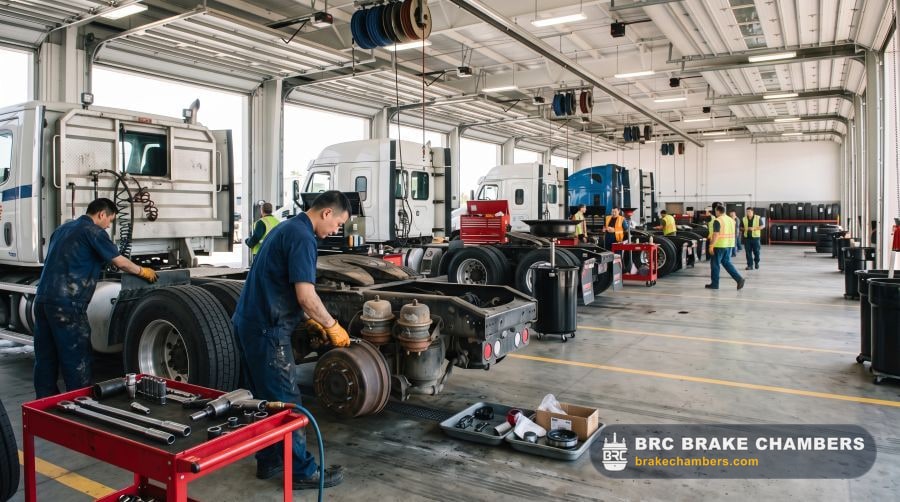
For fleet managers overseeing commercial vehicles, brake maintenance is one of the highest-frequency maintenance categories. A proactive approach to brake chamber replacement reduces unplanned roadside downtime and lowers total cost of ownership.
Preventive Maintenance Intervals
Inspect brake chambers at every preventive maintenance interval (typically every 25,000-30,000 miles). Key inspection points:
- Push-Rod Stroke: Verify stroke length is within legal limits
- Diaphragm Integrity: Check for air leaks at the exhaust port and clamp ring
- Hardware Condition: Inspect clamp ring torque, clevis pins, and air fittings
- Housing Condition: Check for corrosion pitting or cracks
Any chamber showing corrosion, a torn push-rod boot, or a stroke exceeding adjustment limits should be replaced before it results in a roadside violation.
Stocking Strategy
To minimize downtime, keep the most commonly replaced chambers in stock. For a typical North American linehaul fleet, the most frequently replaced chambers are:
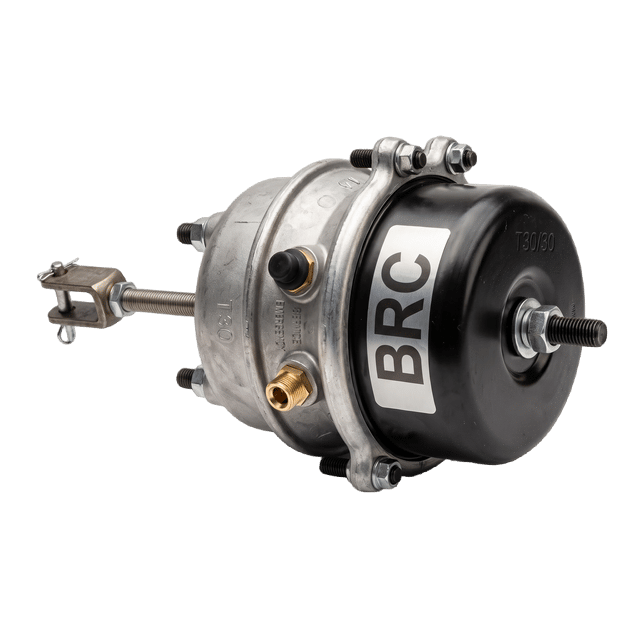
- Type 30/30 Long Stroke: Standard drive axle application
- Type 30 Long Stroke: Standard steer axle application
- Type 24/30 Long Stroke: Common trailer axle application
Exact stocking ratios depend on your fleet mix, but the above covers the majority of typical replacement needs.
Total Cost of Ownership Framework
The true cost of a brake chamber includes:
- Unit cost: The purchase price per chamber
- Installation labor: Time required to replace the chamber
- Roadside failure cost: Downtime, towing, and emergency repair
- Compliance risk: Cost of DOT out-of-service violations
- Replacement frequency: How often each chamber fails
OEM chambers typically deliver reliable service but at a higher unit cost. Top-tier aftermarket chambers deliver comparable performance at a lower unit cost, provided they meet the same specifications.
The evaluation formula:Total cost per mile = (unit cost + installation cost + failure cost) ÷ miles between replacements
For any fleet with meaningful annual replacement volume, factory-direct aftermarket sourcing can meaningfully reduce total cost of ownership without compromising performance.
What to Verify When Evaluating Aftermarket
Before switching to any aftermarket chamber supplier:
- Materials: Steel gauge, diaphragm compound, spring specification
- Testing: Documented test reports to FMVSS-121 or equivalent standards
- Certification: Manufacturer operating under IATF 16949-aligned quality systems
- Cross-Reference: Verified part number matches for your fleet applications
- Warranty: Clear terms and claim process
Summary
Fleet brake maintenance is manageable with three practices:
- Inspect at every PM interval
- Stock the highest-volume chambers
- Evaluate total cost of ownership, not just unit price
BRC manufactures brake chambers for commercial vehicle fleets and distributors. Contact our team to discuss fleet-direct sourcing.
Related Resources:
→ View our brake chamber catalog
→ Use our OEM cross-reference tool
→ Read our warranty policy
Share Article
Need Technical Help?
Our engineering team is available to help you cross-reference OEM parts or select the correct chamber for your fleet.